Laminate flooring installation in Kragujevac
Laminate is installed as a floating floor — it is not bonded to the subfloor but rests on it over a layer of underlay. That makes subfloor flatness decisive: any significant unevenness is later heard as rattling and seen as joints pulling apart.
≤ 3 mm / 2 m
When this is needed
- A fast floor replacement is needed on a limited budget.
- The property is being let or prepared for sale.
- Old carpet or tiles are being replaced without major works.
- A more hard-wearing floor is needed in a high-traffic space.
What an estimate requires
- A photo of the existing subfloor and information about what lies beneath.
- Area per room and the number of transitions between rooms.
- Whether there is underfloor heating, as it changes the underlay and board selection.
- Existing door heights; laminate plus underlay raises the floor level.
How the process runs
Checking and preparing the subfloor
The subfloor must be dry, sound and flat. Unevenness beyond the permitted tolerance is levelled before installation.
≤ 3 mm / 2 m
Laying the underlay
The underlay evens out minor differences and reduces walking noise. On damper subfloors a vapour barrier is added.
Laying the boards
Boards are joined with a click system, with staggered joints between adjacent rows. An expansion gap is left around the entire perimeter.
Skirting and thresholds
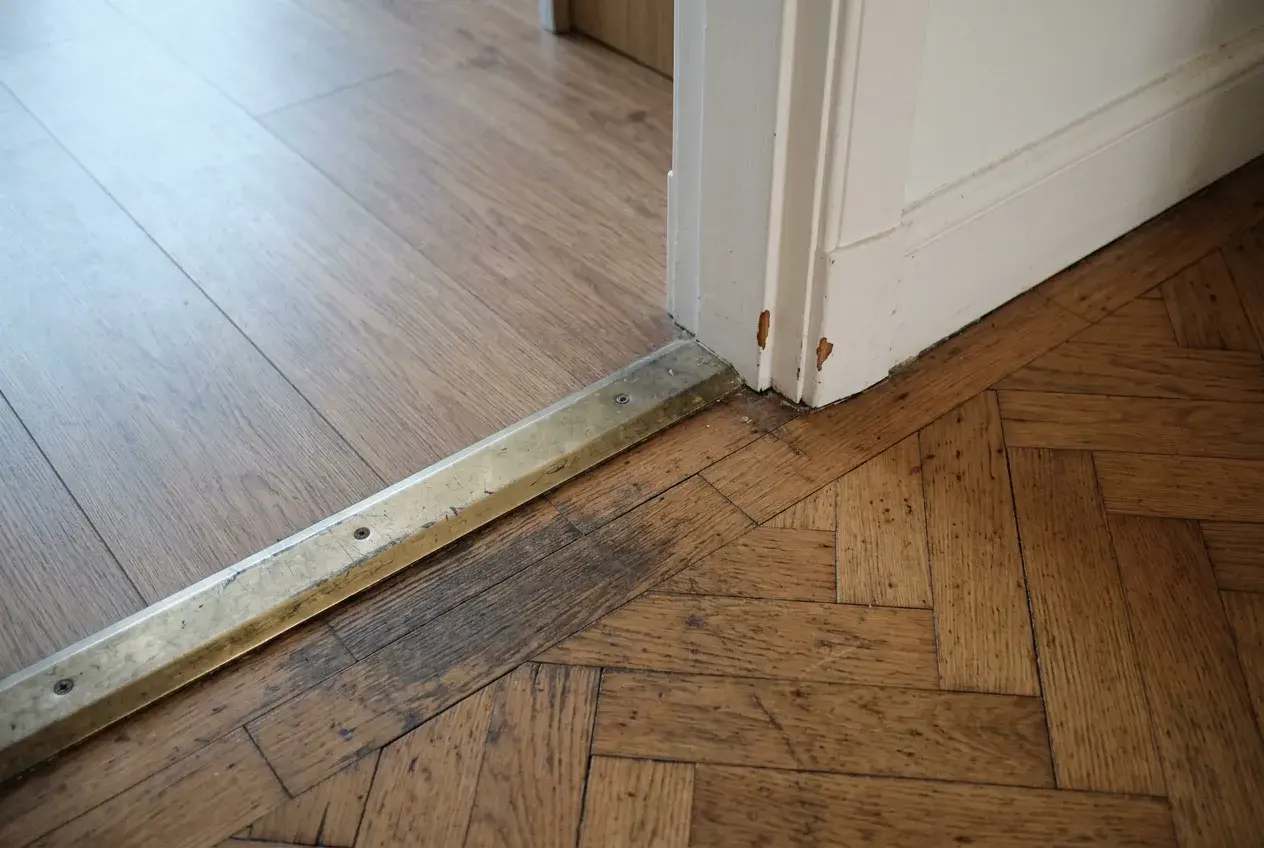
Skirting is fixed to the wall, never to the floor, so the laminate can move freely. Transition profiles are fitted between rooms.
Materials and methods
- The abrasion class determines how much the board withstands; domestic and high-traffic spaces are not the same category.
- A thicker board and better underlay noticeably reduce walking noise.
- Water-resistant boards exist, but laminate in wet rooms still demands caution around the joints.
- A perimeter expansion gap is a condition of correct installation, not an option.
Duration
The installation itself is faster than parquet because there is no sanding and no finish drying. The time depends above all on how much work the subfloor preparation requires.
What drives the price
- Area and number of rooms.
- Extent of subfloor levelling.
- Choice of underlay and any vapour barrier.
- Number of transitions, thresholds and skirting runs.
- Removal and disposal of the old floor.
What this does not solve
- Laminate cannot be sanded or refinished; a damaged board is replaced.
- On an uneven subfloor the joints give way and the floor rattles.
- Water penetrating the joints permanently damages the board core.
- Without a perimeter expansion gap the floor lifts and the joints separate.
When another solution is needed
- If longevity and the ability to renovate matter, parquet is the more justified choice.
- Where a parquet floor already exists in decent condition, renovating it is usually cheaper than laying laminate over it.
Common questions about this service
How long does laminate installation take?
The installation itself is considerably faster than parquet, as there is no sanding and no waiting for a finish to dry. Most of the time usually goes into preparing the subfloor, so the contractor estimates the schedule once its condition is clear.
Can laminate go over old parquet?
It can, if the old floor is flat, dry and firmly bonded to the subfloor, and once door heights are checked. If the parquet moves or squeaks, that problem stays underneath the laminate and gets worse over time.
Is laminate suitable for a bathroom?
Standard laminate is not. Moisture-resistant boards exist, but the joints remain the vulnerable point, so other floor coverings are normally chosen for bathrooms.